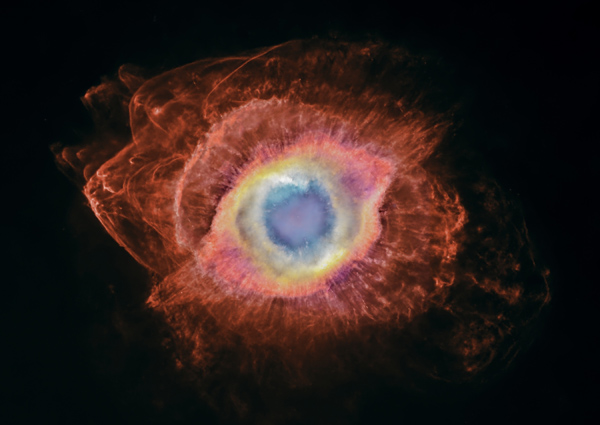
A new image of the Helix Nebula has revealed how dying stars cast off material and return chemical elements back into space. The discovery, published in Nature, shows stellar fragments plowing through gas and breaking down into raw material that can eventually form new stars and planets.
Researchers captured 22 complete or partial bow shocks located in the faint halo on the eastern side of the nebula, about 650 light-years from Earth. These glowing arcs mark the locations where fast-moving clumps of stellar debris collide with surrounding gas.
According to lead author Pieter van Dokkum of the Dragonfly Focused Research Organization and Yale University, the findings capture the handoff of recognizable stellar debris into diffuse gas. The researchers estimate that individual fragments remain coherent for about 10,000 years before being shredded and mixed into interstellar space.
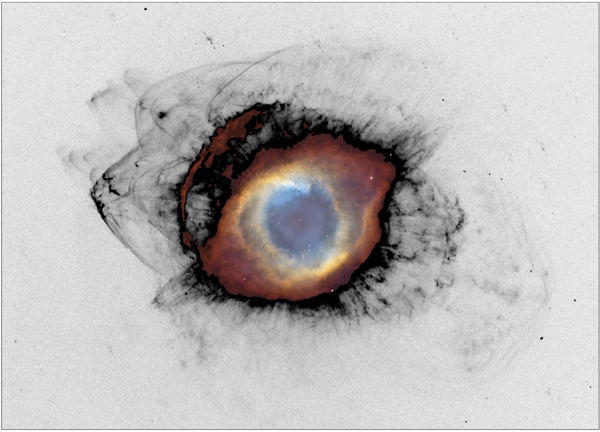
The observations were made using early data from the MOTHRA telescope array, currently under construction at the El Sauce Observatory in Chile. Although the Helix Nebula was initially targeted merely for instrument calibration, the preliminary five-mount array uncovered the network of bow shocks in equivalent to 20 minutes of full-array observing time.
The process offers a preview of the distant future of Earth’s solar system, as the Sun is expected to follow a similar path by expanding, shedding its outer layers, and leaving behind a white dwarf. Co-author Roberto Abraham of the University of Toronto noted that the faint outer region of the nebula revealed a story that had previously been missed by past observations.
Follow us on social media
Facebook • Instagram • Tiktok • Newsbreak
Visit our other sites
Finding Connecticut • Finding New York City • Finding The Hudson Valley • Finding Lehigh Valley • Finding Westport