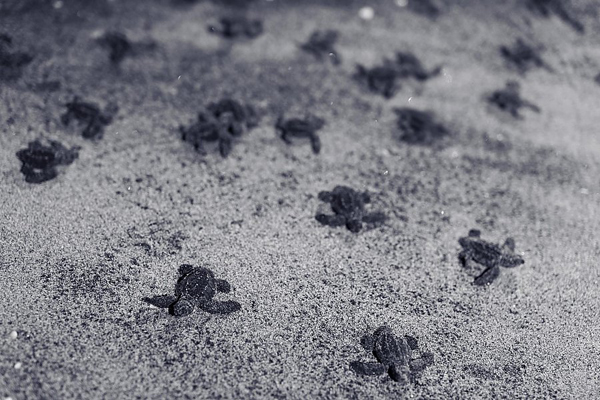
Olive ridley sea turtle hatchlings have been released back into the wild on November 14, 2026, after successfully hatching at the Aquarium of the Pacific. The hatchlings originated from two nests discovered in mid-September in Seal Beach and Huntington Beach, California, marking the first-ever confirmed instance of natural sea turtle nesting on the U.S. West Coast.
Federal officials and local partners, led by the U.S. Fish and Wildlife Service, decided to relocate the eggs because approaching tropical storms threatened to wash away or destroy the nests. Early on Friday, September 25, biologists collected the eggs and transferred them to the Aquarium of the Pacific, where staff kept them in closed incubators under sand inside a temperature and humidity-controlled room at the Molina Animal Care Center. High surf and standing water were later documented near the original nest sites following Tropical Storm Rachel.
Dr. Lance Adams, director of veterinary services at the Aquarium of the Pacific, noted that the viable eggs successfully hatched and the turtles made their journey across the sand to the ocean. Once in the water, hatchlings swim continuously for days to reach deeper ocean waters, facing a low wild survival rate in which only an estimated one in 1,000 reach adulthood.
Researchers do not yet know why the turtles nested in Southern California, though the event could point to an important historical shift for local sea turtle management and protection. Olive ridleys are among the smallest sea turtles, with breeding colony populations on the Pacific coast of Mexico listed as endangered and all other populations listed as threatened. A third nest was documented farther north in Ventura County on November 1, prompting officials to ask beachgoers to watch for tracks in the sand and keep a safe distance from wildlife.
Visitors and the public can learn more about these conservation efforts at the Aquarium of the Pacific’s sea turtle rehabilitation area, which opened in January 2026 and features an audio-visual display alongside a 4,000-gallon rehabilitation pool. Anyone who spots a nesting or distressed sea turtle is asked to notify a local lifeguard or call the 24/7 West Coast Sea Turtle Stranding Hotline at 562-506-4315. The public can also support ongoing turtle care by donating to the Aquarium’s Rescue and Recovery Fund.
The Aquarium of the Pacific is one of only two facilities in Southern California with dedicated spaces to rehabilitate sea turtles, having cared for the animals since 2000 in partnership with the National Oceanic and Atmospheric Administration Fisheries. The facility is currently home to two resident olive ridley sea turtles, Theo and Lou, who arrived in 1999 after their eggs were confiscated during an illegal wildlife trafficking incident. Aquarium volunteers also contribute to local research through the Southern California Sea Turtle Monitoring Project, which studies resident green sea turtles in the San Gabriel River.
Follow us on social media
Facebook • Instagram • Tiktok • Newsbreak
Visit our other sites
Finding Connecticut • Finding New York City • Finding The Hudson Valley • Finding Lehigh Valley • Finding Westport